Literature fingerprinting
ests.visualizers.fingerprinting()
Description
Visualization of literature fingerprinting.
Note
Literature fingerprinting is described in detail in this paper.
Every text is cut into segments of segment_len words with a sliding step of a tenth of a segment, and a measure of lexical diversity is computed for every segment. A text is a block of squares in the order of its segments, row by row, 8 rows high, or a single column when it has at most 8 segments; a block wider than a row of the drawing area wraps into rows of that width. The blocks are laid out left to right and wrap between the rows of an area 2 · x_size wide, which grows downwards from 2 · y_size when they need more height, so nothing is cut off. The colour of a square is the value of the measure on the scale of the colorbar, from its smallest to its greatest finite value over all the texts; the default map is sequential, since the middle of a measure means nothing. Segments where the measure is undefined (nan on segments too short for it) and the empty cells of a block are light grey, apart from every value, zero included.
Parameters
| Parameter | Type | Default | Description |
|---|---|---|---|
texts |
list[list[str]] | - |
List of lists of words |
segment_len |
int | 10 |
Size of a segment |
metric |
Callable | None |
Function of a measure of lexical diversity; calc_ttr by default |
x_size |
int | 800 |
Half the width of the drawing area |
y_size |
int | 600 |
Half the height of the drawing area, which grows when the blocks need more |
cmap |
str | 'viridis' |
Colour map |
ax |
Axes | None |
Axes of matplotlib for the plot; if not given, a 15×10 figure is created |
The function returns the Axes with the visualization, set to an equal aspect so that the squares stay square; the figure is ax.figure.
Usage example
The first five windows of 1000 words of six novels from Project Gutenberg, three by Galdós and three by Unamuno, by Simpson's index.
Example
Code:
from urllib.request import urlopen

from ests import WordsExtractor
from ests.corpus import split_windows
from ests.diversity_stats import calc_simpson_index
from ests.visualizers import fingerprinting


def gutenberg(number):
    url = f"https://www.gutenberg.org/cache/epub/{number}/pg{number}.txt"
    text = urlopen(url).read().decode("utf-8")
    start = text.index("\n", text.index("*** START OF"))
    return text[start : text.index("*** END OF")]


we = WordsExtractor(lowercase=True)
texts = [
    we.extract(window)
    for number in (17340, 21831, 15206, 49836, 44512, 44358)
    for window in split_windows(gutenberg(number), 1000)[:5]
]
fingerprinting(texts, segment_len=100, metric=calc_simpson_index, x_size=1000, y_size=330)
Result:
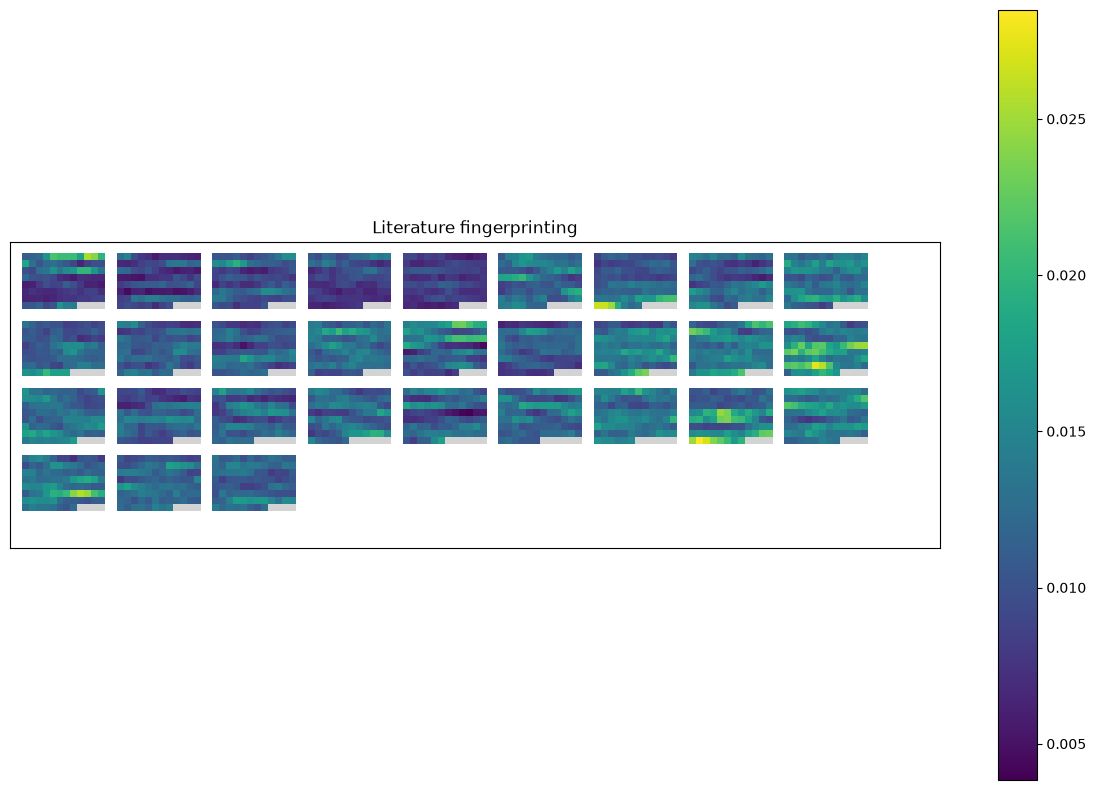
The first fifteen blocks are Galdós, the last fifteen Unamuno. Simpson's index - the probability that two words drawn at random are the same - is lower in Galdós (a median of 0.0107 against 0.0127 over the segments), so his blocks are darker and Unamuno's, who repeats his words more, greener.