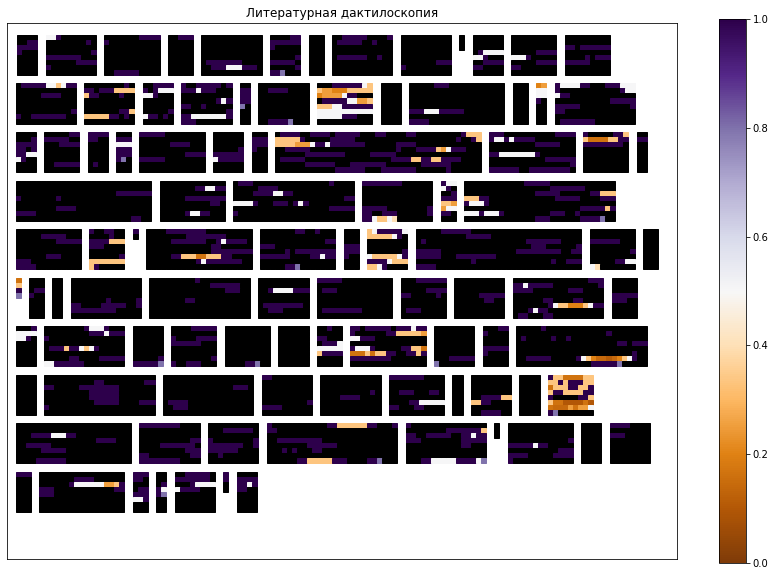
Literature fingerprinting
ruts.visualizers.fingerprinting()
Description
Literature Fingerprinting visualization.
Note
Literature fingerprinting is described in detail in this paper.
Parameters
| Parameter | Type | Default | Description |
|---|---|---|---|
texts |
List[List[str]] | - |
List of word lists |
segment_len |
int | 10 |
Segment size |
metric |
Callable | None |
Function computing a lexical diversity metric |
x_size |
int | 800 |
Width of the drawing area |
y_size |
int | 600 |
Height of the drawing area |
cmap |
str | 'PuOr' |
Color map |
ax |
Axes | None |
matplotlib axes for the plot; if not given, a 15×10 figure is created |
The function returns the Axes with the visualization; the figure is available as ax.figure. The color of a square is the metric value of the segment relative to the maximum over all texts; segments where the metric is undefined (nan on segments too short for it) are drawn as zeros rather than disappearing from the plot.
Usage example
Let us look at the visualizer on 100 texts of the SovChLit dataset.
Example
Code:
# Import the libraries
from ruts import WordsExtractor
from ruts.datasets import SovChLit
from ruts.diversity_stats import calc_simpson_index
from ruts.visualizers import fingerprinting

# Prepare the data
sc = SovChLit()
texts = [text for text in sc.get_texts(limit=100)]

# Build the list of word lists
words = []
words_extractor = WordsExtractor(lowercase=True)
for text in texts:
    words.append(words_extractor.extract(text))

# Plot
fingerprinting(words, metric=calc_simpson_index, x_size=1000, y_size=800)
Result: