Parser
Parser(path=None)
A dependency parser: for every word of a sentence it finds the head - the word it depends on - and the Universal Dependencies relation. The head is the number of a word in the sentence starting from 1; the root of the sentence has 0. Without path the package model is used: it is built into the module and loaded once per process (about 10 ms), so a new parser is created instantly. Parsers share a model from a file too - also by another path or link to the same file: while the file does not change, it is loaded once, and the last loaded one stays in memory without parsers too.
Exceptions:
FileNotFoundError- there is no model file;OSError- the model file cannot be read: no access, the path points to a directory;ValueError- the file is not a ruSyntax model, the model has another format version or the file is damaged (the checksum does not match);TypeError- the path is neither a string noros.PathLike.
from rusyntax import Parser

parser = Parser()
document = parser.parse_text("Кошка, которую я вчера видел, спала на крыльце.")
[(word.form, word.head, word.deprel) for word in document.words]
[('Кошка', 8, 'nsubj'), (',', 6, 'punct'), ('которую', 6, 'obj'), ('я', 6, 'nsubj'), ('вчера', 6, 'advmod'), ('видел', 1, 'acl:relcl'), (',', 1, 'punct'), ('спала', 0, 'root'), ('на', 10, 'case'), ('крыльце', 8, 'obl'), ('.', 8, 'punct')]
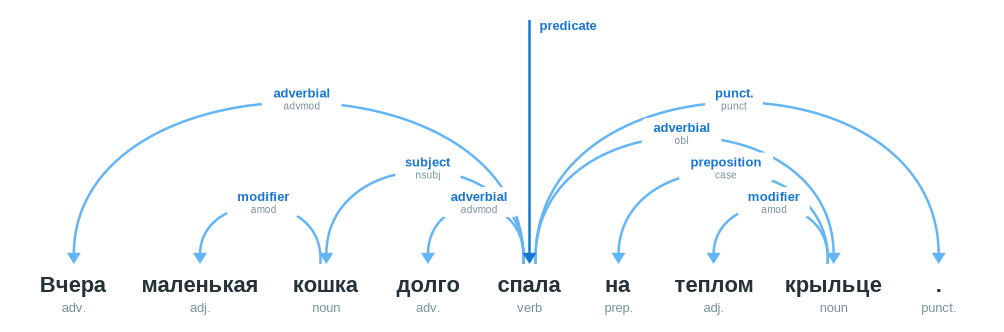
A parse reads well as arcs: each goes from the head to the dependent and is labeled with the relation. The labels in the picture are the school terms for the parts of a sentence, with the UD relation the parser returns under each; the correspondence is approximate: in UD, for example, the prepositional phrase «на теплом крыльце» is obl, and the preposition «на» depends on the noun (case).
Parameters
| Parameter | Type | Default | Description |
|---|---|---|---|
path |
str / PathLike |
None |
A ruSyntax model file; the package model by default |
Read-only properties:
| Property | Type | Description |
|---|---|---|
path |
Path / None |
The absolute path to the model file; None for the package model |
relations |
list[str] |
The relations of the model with subtypes: nsubj, obl:tmod, root and others |
sources |
dict |
About the model: the checksum crc32 (the CRC32 of the model file after its header, which tells one model from another) and how the model was trained - the UD release, the treebanks and their commits, the ruMorph version, LAS on dev |
Methods
Parsing a text
parse_text(text, *, segmenter=None, analyzer=None)
Splits the text into sentences and words with the anySeg segmenter, gives the words the lemma, part of speech and features of the ruMorph morphological analyzer in context and finds the head and relation of every word. Returns an anySeg document (anyseg.Document) with the columns lemma, upos, feats, head and deprel: its words, sentences and CoNLL-U output are described in the anySeg documentation. The default segmenter and analyzer are created on the first call and reused afterwards; your own - a segmenter with your abbreviations or an analyzer with your words, for example - are passed as parameters. The parser does not change the sentence boundaries of anySeg.
| Parameter | Type | Default | Description |
|---|---|---|---|
text |
str |
The text | |
segmenter |
anyseg.Segmenter |
None |
A segmenter or an object with the segment method; by default Segmenter("ru") |
analyzer |
rumorph.Analyzer |
None |
A morphological analyzer or an object with the annotate method; by default Analyzer() |
Exceptions: TypeError - the text is not a string, the segmenter has no segment method, segment returned no document or the analyzer has no annotate method; ValueError - the analyzer gave the words no parts of speech.
document = parser.parse_text("Мы стали друзьями.")
print(document.to_conllu())
# newdoc
# newpar
# sent_id = 1
# text = Мы стали друзьями.
1   Мы  мы  PRON    _   Case=Nom|Number=Plur|Person=1|PronType=Prs  2   nsubj   _   _
2   стали   стать   VERB    _   Aspect=Perf|Mood=Ind|Number=Plur|Tense=Past|VerbForm=Fin|Voice=Act  0   root    _   _
3   друзьями    друг    NOUN    _   Animacy=Anim|Case=Ins|Gender=Masc|Number=Plur   2   xcomp   _   SpaceAfter=No
4   .   .   PUNCT   _   _   2   punct   _   _
An abbreviation the segmenter does not know splits the sentence; your own segmenter knows it:
from anyseg import Segmenter

segmenter = Segmenter("ru", abbreviations=["прапорщ."])
document = parser.parse_text("Звонил прапорщ. Петров.", segmenter=segmenter)
[(word.form, word.head, word.deprel) for word in document.words]
[('Звонил', 0, 'root'), ('прапорщ.', 1, 'nsubj'), ('Петров', 2, 'flat:name'), ('.', 1, 'punct')]
Parsing a document
annotate(document)
Fills the head and deprel columns of an anySeg document; the previous values are replaced. The parts of speech and features come from the upos and feats columns, so the document gets its morphology first - usually with rumorph.Analyzer().annotate(document). The document is an anyseg.Document or an object with the same interface: column(name), sentences (a sentence has words, a word has index) and set_columns. The enhanced graph (the deps column) and the empty nodes of a CoNLL-U document are not changed. Parsing runs without the GIL.
Exceptions:
ValueError- a word has no part of speech, a part of speech is not one of the 17 UD parts of speech, or the sentences of the document do not follow each other over all its words;TypeError- this is not a document (parse_textparses a text), the columns of the document are not strings, or a word number is not an integer.
from anyseg import Segmenter
from rumorph import Analyzer

document = Segmenter("ru").segment("Мама мыла раму.")
Analyzer().annotate(document)
parser.annotate(document)
document.column("head"), document.column("deprel")
([2, 0, 2, 2], ['nsubj', 'root', 'obj', 'punct'])
Parsing a sentence
parse(words, upos, feats, *, probs=False)
The head and relation of every word of the sentence in the same order; an empty sentence gives an empty list. The words come with their part of speech and features in the UD annotation - as ruMorph gives them. The part of speech is one of the 17 UD parts of speech in capitals (NOUN, VERB, X): with other tags, lowercase or OpenCorpora ones for example, the model would parse almost at random, so they are an error. The features are a CoNLL-U field (Case=Nom|Number=Sing) or a dictionary, like feats of a ruMorph analysis; _, an empty string, an empty dictionary or None mean no features. Features unknown to the model are skipped. The features should be complete, as ruMorph gives them: without features LAS on dev is 5.7 points lower, with only case, gender and number 3.2 lower, without the aspect of a verb 2.2 lower. Parsing runs without the GIL.
| Parameter | Type | Description |
|---|---|---|
words |
Iterable[str] |
The word forms |
upos |
Iterable[str] |
The UD parts of speech |
feats |
Iterable[str \| Mapping[str, str] \| None] |
The UD features of every word |
probs |
bool |
Add the probabilities of the head and the relation: quadruples instead of pairs |
Exceptions:
ValueError- the lengths ofwords,uposandfeatsdiffer, or a part of speech is not one of the 17 UD parts of speech;TypeError- the input is not a collection of strings (a string instead of a list is an error too) orprobsis not a bool.
parser.parse(
    ["Я", "читаю", "книгу"],
    ["PRON", "VERB", "NOUN"],
    [
        "Case=Nom|Number=Sing|Person=1|PronType=Prs",
        "Aspect=Imp|Mood=Ind|Number=Sing|Person=1|Tense=Pres|VerbForm=Fin|Voice=Act",
        "Animacy=Inan|Case=Acc|Gender=Fem|Number=Sing",
    ],
)
[(2, 'nsubj'), (0, 'root'), (2, 'obj')]
If the text is already split into words, ruMorph gives them the morphology in context: the first analysis of every word is the one its context model picked.
from rumorph import Analyzer

words = ["Кошка", "спала", "на", "крыльце", "."]
best = [analyses[0] for analyses in Analyzer().analyze_sentence(words)]
parser.parse(words, [a.pos for a in best], [a.feats for a in best])
[(2, 'nsubj'), (0, 'root'), (4, 'case'), (2, 'obl'), (2, 'punct')]
Parsing many sentences
parse_many(sentences, *, probs=False)
The same as parse for every sentence, but faster: sentences of close lengths are parsed four at a time. A sentence is a triple (forms, parts of speech, features); probs=True adds the probabilities, as in parse. Parsing runs without the GIL in chunks of 256 sentences; Ctrl+C works between them.
Exceptions: ValueError - a sentence is not three collections, their lengths differ, or a part of speech is not one of the 17 UD parts of speech; TypeError - the input is not a collection of strings or probs is not a bool.
parser.parse_many(
    [
        (["Привет", "!"], ["INTJ", "PUNCT"], [None, None]),
        (["Идет", "дождь"], ["VERB", "NOUN"], ["_", "Case=Nom"]),
    ]
)
[[(0, 'root'), (1, 'punct')], [(0, 'root'), (1, 'nsubj')]]
Probabilities
With probs=True every word has, besides its head and relation, two probabilities from the model: head_prob of the head among all the words of the sentence and the root (in a sentence longer than 1024 words, among the candidates of the window and the head given by building the tree), and deprel_prob of the relation given this head among the relations other than root; the root relation of the root and the vocative relation of a mention @name at the start of a sentence are set by the rule, and their probability is 1. Their product is the probability that the relation is right as a whole. The probabilities tell reliable relations from doubtful ones: on dev Taiga, GSD and SynTagRus the head is right for 98-99 % of the words with head_prob from 0.99 (52-68 % of the words), and for about 40 % below 0.5 (3-8 % of the words). The probabilities are local - per word, not per tree - and slightly high: the mean head_prob is 2-5 points above the share of right heads, and their product 3-8 points above the share of right relations.
words = ["Я", "видел", "девочку", "с", "биноклем", "."]
best = [analyses[0] for analyses in Analyzer().analyze_sentence(words)]
relations = parser.parse(words, [a.pos for a in best], [a.feats for a in best], probs=True)
[
    (word, head, deprel, round(p, 2), round(q, 2))
    for word, (head, deprel, p, q) in zip(words, relations)
]
[('Я', 2, 'nsubj', 1.0, 1.0), ('видел', 0, 'root', 1.0, 1.0), ('девочку', 2, 'obj', 1.0, 1.0), ('с', 5, 'case', 1.0, 1.0), ('биноклем', 2, 'obl', 0.57, 1.0), ('.', 2, 'punct', 1.0, 1.0)]
The parse tree
Every word has one head, a sentence has one root, and there are no cycles; non-projective trees (crossing relations) are allowed. The parser picks the tree with the highest sum of head scores (the Chu - Liu - Edmonds algorithm). For degenerate sentences, where the best heads give more than 16 cycles or 8 root candidates, the tree is built faster: the extra roots and the nodes of cycles are attached to the best root. The tree of a sentence longer than 1024 words is built the same way - text without punctuation, for example, which the segmenter does not split into sentences; the head of a word in it is looked for among 64 words on each side and the root, so the parsing time grows linearly with the length. The relations come with subtypes, as in the UD annotation (nsubj:pass, obl:tmod); only the root has the root relation; the CoNLL 2018 evaluation compares the relation without the subtype. A mention @name at the start of a sentence, unless it is the root, is an address to the root of the sentence (vocative), as UD annotates it: the training treebanks have few such mentions, and the model hardly recognizes them by itself.
Threads and processes
The parser does not change while parsing: one parser can be shared between threads, and parsing runs without the GIL, so the threads parse in parallel. On Python 3.14t and 3.15t without the GIL the module does not enable the GIL. The parser moves to another process with pickle: the absolute path to the model, or the mark of the package model, is saved. copy.copy and copy.deepcopy return the same object. Parsers are equal if their model comes from the same file (also by another path or link) that did not change between their creation, or both use the package model; a parser can be held by a weak reference (weakref).