Comparison
esMorph analyzes a word without context and gives all its analyses, the most probable first. Its first lemma is right more often than that of simplemma on all three UD test sets and of spaCy es_core_news_sm on PUD and COSER, and its first analysis has the right UD features more often than both taggers on PUD; an analysis with the right part of speech and lemma is among the analyses of esMorph for 96-99 % of words. It conjugates verbs more accurately than ablaut and verbecc. It analyzes 1.2 million tokens per second, 28 times faster than spaCy and 456 times faster than Stanza, answers a short text together with loading in 3.5 ms, and every further process with the same dictionary adds 3.6 MB of memory.
Quality
The gold standard is the test parts of the UD Spanish AnCora, GSD, PUD and COSER treebanks from the UD 2.18 release: news, web texts, translated Wikipedia sentences and rural speech. Every system gets their words, with del as de and el and a verb apart from its clitics, punctuation is not counted, and lemmas are compared ignoring case. The lemmas and features of GSD are assigned automatically, so only the part of speech is compared on it. The treebanks follow different conventions, so systems should be compared on the same set rather than sets against each other.
AnCora is the home set of the taggers and of esMorph: spaCy es_core_news_sm is trained on AnCora, the default Stanza model on AnCora and GSD, and esMorph takes its conventions and the frequencies of its analyses from the training parts of AnCora and GSD. PUD and COSER are new to all of them.
Lemma
The share of words with the right lemma, %; for esMorph - the lemma of the first analysis, for a word without analyses - the word in lower case, as lemmatize gives it:
| System | AnCora | PUD | COSER |
|---|---|---|---|
| esMorph | 97.80 | 97.74 | 94.49 |
| simplemma | 96.94 | 96.96 | 93.50 |
| spaCy es_core_news_sm | 98.66 | 96.69 | 93.39 |
| Stanza | 99.16 | 97.80 | 94.98 |
simplemma gives only a lemma, from a dictionary without parts of speech.
Part of speech and features
Taggers choose the analysis by the sentence. esMorph does not see the sentence, so for a word such as que, la or como its first analysis is the most frequent one; on the sets new to the taggers its features are nevertheless right more often than theirs on PUD and as often as spaCy's on COSER.
The share of words with the right part of speech, features (gender, number, person, tense, mood, verb form; for names and numerals they are not compared, PUD gives them a gender and a number) and all together with the lemma, %; for esMorph - the first analysis, and the oracle - at least one of its analyses has the right part of speech and lemma:
| System | Part of speech | Features | All together | Oracle |
|---|---|---|---|---|
| esMorph | 92.22 | 96.14 | 90.05 | 98.94 |
| spaCy es_core_news_sm | 97.12 | 97.90 | 95.92 | - |
| Stanza | 98.57 | 99.06 | 97.50 | - |
| System | Part of speech | Features | All together | Oracle |
|---|---|---|---|---|
| esMorph | 91.57 | 92.06 | 87.90 | 97.19 |
| spaCy es_core_news_sm | 90.31 | 88.38 | 83.59 | - |
| Stanza | 92.94 | 89.82 | 86.34 | - |
| System | Part of speech | Features | All together | Oracle |
|---|---|---|---|---|
| esMorph | 90.11 | 93.25 | 86.87 | 96.41 |
| spaCy es_core_news_sm | 90.00 | 93.14 | 85.79 | - |
| Stanza | 93.60 | 94.64 | 89.16 | - |
| System | Part of speech |
|---|---|
| esMorph | 92.43 |
| spaCy es_core_news_sm | 90.29 |
| Stanza | 93.39 |
Inflection
The share of verbs whose form the system gives for their gold lemma and features (infinitive, gerund, participle, mood, tense, person and number), %. Every system gets only the lemma and the features: esMorph is scored by inflect of its verb and auxiliary lexemes of the lemma, one form of each, ablaut and verbecc by any form of the cell of their conjugation table:
| System | AnCora | PUD | COSER |
|---|---|---|---|
| esMorph | 99.65 | 93.29 | 95.55 |
| ablaut | 98.87 | 92.71 | 93.61 |
| verbecc | 95.37 | 92.91 | 93.53 |
On AnCora most misses of ablaut and verbecc are the third person singular of the present of haber: ablaut gives only ha and verbecc only hay, while esMorph has both, ha of the auxiliary and hay of the verb; verbecc also fails on pasar, resultar and suceder, which count as misses. On PUD most misses of all three are a convention: the auxiliaries ha and había of compound tenses have Tense=Past; COSER has spoken forms such as trabajao and tá. For the imperfect subjunctive esMorph and ablaut give the form in -ra (fuera), so a form in -se (fuese) is a miss for them.
Speed
Text analysis
The time to analyze a text together with importing and loading the system in a new process, seconds, both axes on a logarithmic scale:
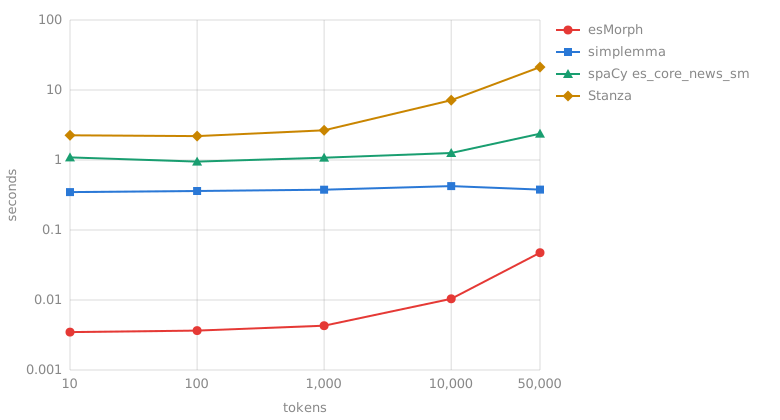
On a short text almost all the time goes to loading: esMorph answers in 3.5 ms, simplemma in 0.35 s, spaCy in 1.1 s, Stanza in 2.3 s. On a long text the analysis speed decides, tokens per second without loading, more is better:
| System | Tokens per second |
|---|---|
| simplemma, lemmas only | 2,507,937 |
| esMorph | 1,228,661 |
| spaCy es_core_news_sm | 44,100 |
| Stanza | 2,694 |
esMorph gives all the analyses of a word, with features and probabilities; its lemmatization alone is as fast as simplemma, see Operations.
Operations
Thousands of words, analyses or tables per second, more is better:
| Operation | esMorph | simplemma | ablaut | verbecc |
|---|---|---|---|---|
Analysis of a word form: analyze in a loop |
1,167 | - | - | - |
Analysis of a list: analyze_many |
1,221 | - | - | - |
Lemmatization: lemmatize, lemmatize(word, lang="es") |
2,042 | 2,133 | - | - |
Lemmatization in 4 threads: lemmatize |
6,852 | - | - | - |
Form of a noun or an adjective: inflect(Number="Plur") |
1,470 | - | - | - |
Form of a verb: inflect(Mood="Sub", Tense="Pres", Person="1", Number="Sing") |
374 | - | - | - |
Conjugation table: forms(), conjugate(lemma) |
117 | - | 1.8 | 1.0 |
simplemma keeps its answers in a cache: with the cache filled by an earlier run over the same words it lemmatizes 5.4 million words per second. ablaut and verbecc build a form only as part of the whole table. lemmatize releases the GIL, so threads sharing one analyzer run in parallel.
Loading and memory
| esMorph | simplemma | spaCy es_core_news_sm | Stanza | |
|---|---|---|---|---|
| Import and loading | 3.6 ms | 0.31 s | 0.85 s | 1.7 s |
| Growth of process memory | 10.6 MB | 131 MB | 305 MB | 577 MB |
| Every further process | 3.6 MB | 129 MB | 325 MB | 0.6-1.0 GB |
The dictionary file of esMorph is mapped into memory, so multiprocessing or joblib processes and web server workers share it: most of the 10.6 MB of the first process is the dictionary, and every further process adds only its own tables and analyses.
How it was measured
- Quality, inflection and text analysis - the
scripts/compare.pyscript:uv run scripts/compare.py target/compare --chart docs/img/speed.svg. It installs the systems into a separate environment with the versions of all packages pinned inscripts/compare.py.lock(esMorph - the version from it, or a wheel withuv run --with dist/esmorph-*.whl, as for this page), downloads the treebank test parts and the Stanza model with checksum verification before measuring and analyzes the gold words. Inflection - the 5,939, 2,893 and 1,237 verbs of AnCora, PUD and COSER whose lemma is an infinitive, without typos and foreign words. - Versions: Python 3.11, esMorph 0.1.0, simplemma 2.0.0, spaCy 3.8.16 with the es_core_news_sm 3.8.0 model without the parser and NER, Stanza 1.15.0 with the default model on the CPU (torch 2.15.0), ablaut 0.11.0, verbecc 2.0.3 (the package has no model and trains one at the first run, so its figures vary by up to 0.2 between installations). Computer - Apple M3 Pro, macOS 26, with other applications running (load average about 4), so the speeds are an order of magnitude.
- Text analysis speed - the 53,622 tokens of the AnCora test part with punctuation: tokens per second - the best of two analyses of the whole part after loading, chart points - importing, loading and analyzing the first 10-50,000 tokens in a new process. Only the call of the system is measured: esMorph
analyze_manyof all the words, simplemmalemmatizeof each word with an empty cache, spaCynlp.pipeof the sentences, Stanza the whole text; esMorph and simplemma run in one thread, spaCy and Stanza with their default settings. - Operations - 47,288 words of the AnCora test part without punctuation, the best of three runs in one thread, except the row with threads; verbs - the lexemes of the 4,634 gold verbs whose lemma is an infinitive (verbecc - the first 2,000, one run). Loading and memory - importing, creating the analyzer and the first analysis, the growth of the resident memory of the process (
ps -o rss), the median of three runs; a further process - the growth of the memory the process does not share with others (USS), in each of fourmultiprocessingprocesses that load the system and analyze 200 sentences.